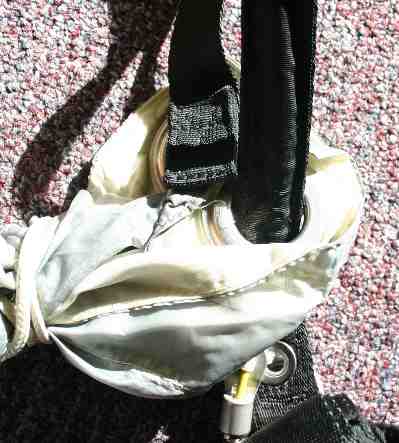
The CYPRES2 is waterproof for up to 24 hours down to 5 feet. If the unit gets wet, the filter must be replaced.
You will need a water filter replacement tool from Airtec and a new filter. Place the tool onto the filter and twist counterclockwise to remove the older filter. Dry any remaining water where the water filter is located.
Note: Vigil Manufacturer, AAD, no longer supplies batteries for replacement by the user or riggers. Vigil owners must now send their units into Vigil America or AAD to have the battery replaced (see here). These instructions below were made when the batteries were available separately.
The Vigil II battery is designed to last a minimum of 2000 jumps. The manufacturer recommends replacement at 5 years and mandates replacement at 10 years.
The Cutter and Display are replaceable by your local rigger. The Display must be of the correct version for your unit, so check with the manufacturer. All Vigil II displays are interchangeable.
Unscrew both Phillips head closing screws and separate the main box casing. Gently lift-up and remove the cutter or display, keeping the rubber seal in place. Insert the new cutter or display through the rubber seal without damage. Seat the rubber seal in the appropriate grooves.
Note: Video states a 1-year replacement period for Argus batteries, but the manufacturer has since changed its requirement to every repack, 500 jumps or Batt Low reading.
Two CR123A Lithium batteries are to be replaced every repack, every 500 jumps or when the unit displays Batt Low or Batt Rpl.
Unscrew Phillips head closing screw. Remove old batteries. Insert new batteries noting the polarity marks on the outside of the unit. Re-install battery back plate and tighten closing screw to snug.
Past posts on rigging forums at one time focused on one manufacturer's solution to keeping a collapsed slider at the base of the risers after opening without anchoring the slider to the container. Many jumpers have concerns about a number of slider holders that connect the slider to the top of the reserve container, which could potentially cause a cutaway delay.
When Team Method (Steve-O Utter, T.J. Landgren and Nate Gilbert) arrived at Atlanta Skydiving Center in 2001, the freefly team showed-off a new slider block design. Over the next few years, ChutingStar riggers tweaked and modified the design for strength, durability and aesthetics.
This is often a topic of debate, how do you determine whether a canopy is Crossfire or a Crossfire 2 and how to determine the difference between a Safire and a Safire 2. There are some quick and dirty ways to tell the difference. Unfortunately, we see some crazy things in this sport so the only sure fire way to know is to submit the serial number to manufacturer so they can scour the archives. Continue reading →
Here's some info and a video of installing one type of main pilot chute. While each main pilot chute may have a slightly different attachment part, the general idea is the same.
This Cazer pilot chute came with two metal links. We prefer to substitute those two metal links with a PD Reserve Slink and a PD Main Slink. The reserve soft link is used to attach the bridle to the inside of the main D-bag. The main soft link is used to attach the end of the bridle to the top of the canopy. Continue reading →
Hidden behind flaps, under grommets and inside your container are tiny pieces of metal that can end your Sky God status in a hurry. In an ideal world, all the metal in skydiving is polished, shiny and smooth as silk. But manufacturing issues, abnormal wear and just plain sharp edges can lead to frayed and broken loops in your main and reserve container. The inspection is easy; a little bit of time and some basic knowledge on what to look for will go a long way in keeping your container closed when you need it to be. You can also save yourself from having to constantly replace your loops.
Washing your harness/container every few years can keep your investment looking brand new. You'll be surprised how clean and bright a used container can get with a thorough washing.
Below are tips and a step-by-step "how to" guide for washing your harness/container. These tips have been taken from several manufacturers, riggers and my own experience of washing a few hundred rigs over the past 10 years. Continue reading →


 Vigil II: Battery Replacement